VIA ORIGINAL
YOUR BUSINESS MAY BE BETTER THAN IT LOOKS ONLINE
Why the gap between real business quality and online perception matters more in 2026.
VALENTYNA DYNOVSKA · Founder & Creative Director
A business can be excellent at what it does and still look remarkably ordinary online.
The product may be considered. The service may be exceptional. The founder may have years of expertise. Clients may already trust the business and recommend it.
And yet someone encountering it for the first time through Instagram, LinkedIn, Google or its website may see something else entirely.
An unclear offer. Inconsistent imagery. A social feed that could belong to almost anyone. Important information that takes too long to find. Content produced regularly, but without a recognisable point of view.
The problem is not necessarily the business.
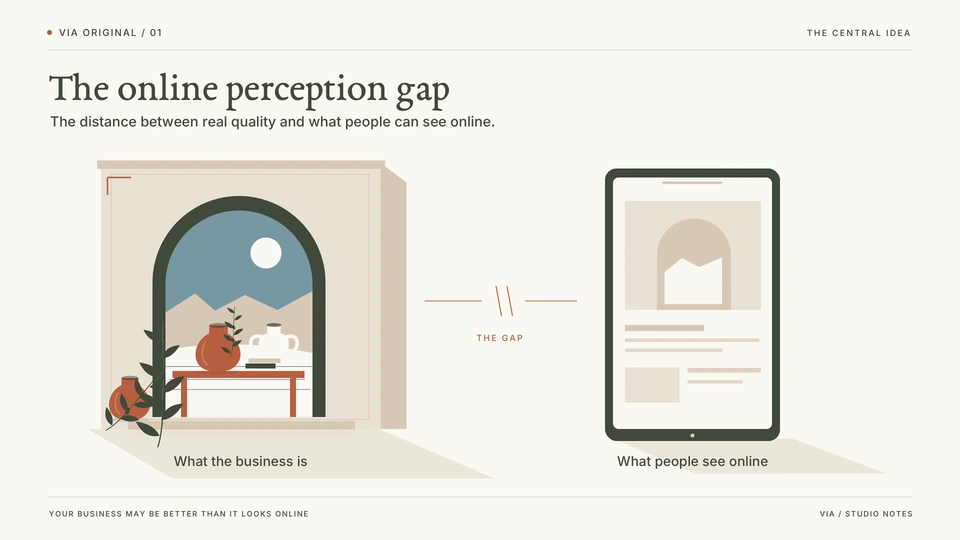
It is the distance between what the business actually is and what its digital presence allows people to perceive.
I think of this as the online perception gap.
And in 2026, that gap matters more than it used to.
01. PEOPLE CANNOT SEE THE QUALITY THEY HAVE NOT YET EXPERIENCED
For an existing client, reputation is built through experience.
For a prospective client, it often begins with representation.
Before someone experiences the service, visits the property, speaks to the founder, touches the product or sees the quality of the work, they encounter its digital signals.
Design. Language. Photography. Information. Social presence. Reviews. Responsiveness. Consistency.
None of these things proves that a business is good.
But they help people decide whether it appears credible enough to investigate further.
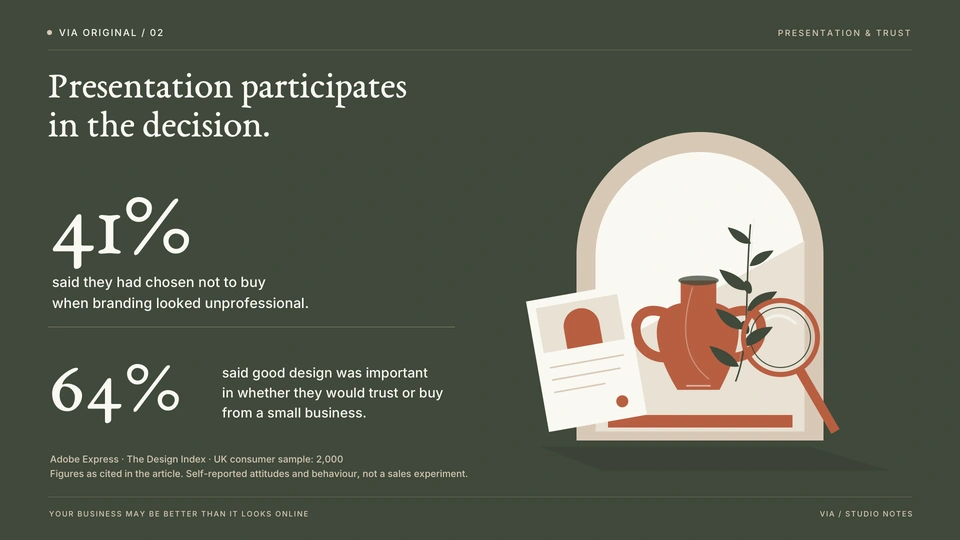
Recent research from Adobe makes that relationship unusually tangible. In a survey of 2,000 UK consumers, 64% said good design was important in influencing whether they would trust or buy from a small business. More strikingly, 41% said they had chosen not to buy when branding looked unprofessional. Adobe
That should not be interpreted as proof that better design automatically produces more sales. The study measures self-reported consumer attitudes, not controlled purchasing behaviour.
But it does tell us something important.
Presentation participates in the decision.
For a business that has already invested heavily in the quality of what it delivers, weak presentation can therefore create an unnecessary disadvantage: the customer has to work harder to discover that the business is better than it first appears.
That is the first form of the perception gap.
02. PROFESSIONAL DOES NOT MEAN POLISHED FOR THE SAKE OF IT
It is tempting to reduce this conversation to aesthetics.
Better photography. A nicer website. A cleaner Instagram grid.
But that misses the more interesting point.
Professional presentation is not simply decoration around a business. At its best, it makes the business easier to understand.
What is this?
Who is it for?
What is different about it?
What can I buy?
How does it work?
Why should I trust it?
What should I do next?
Good digital presentation answers these questions with as little friction as possible.
This is why a beautiful website can still be weak. It can have impeccable typography, expensive photography and elegant animation while leaving a visitor uncertain about what the company actually offers.
Equally, a visually modest business can communicate extremely well if its proposition, information and next steps are unmistakably clear.
The strongest digital presence does both.
It creates desire and comprehension.
It gives the business an atmosphere, but it also gives the customer answers.
03. A PRETTY INSTAGRAM IS NOT A VISUAL SYSTEM
This distinction is particularly important on social media.
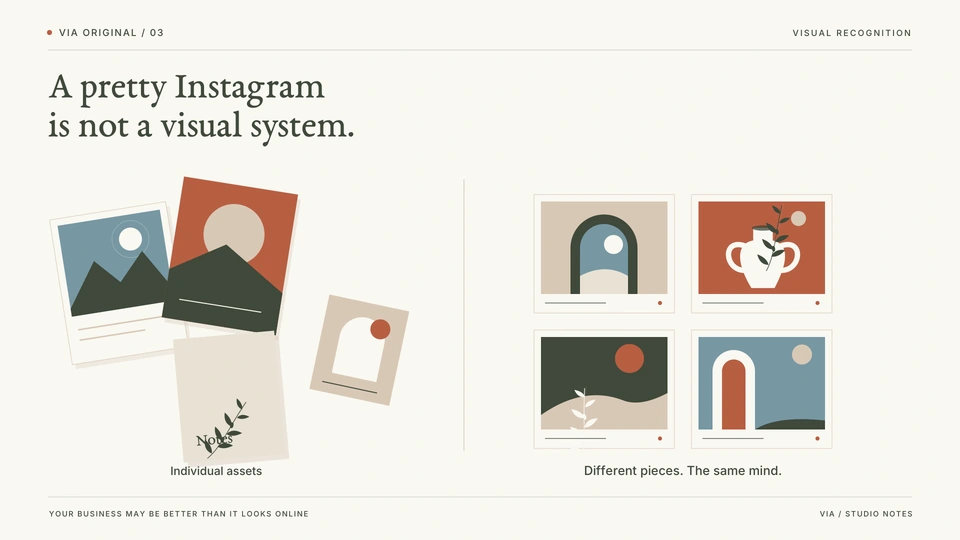
A brand can have a collection of beautiful posts without having a recognisable identity.
A strong photograph performs well. Then another is created in a completely different direction. A Reel follows a trend. A graphic uses a new template. A campaign introduces another aesthetic.
Individually, everything may look perfectly acceptable.
Collectively, very little accumulates.
A visual system works differently.
It establishes enough continuity across photography, composition, colour, typography, motion, language and recurring formats that individual pieces begin to reinforce one another.
The objective is not to make every post identical.
It is to make different pieces feel as though they come from the same mind.
This matters because social media has become extraordinarily crowded. Sprout Social's 2026 research found that 66% of consumers had become more selective about the content they engage with compared with a year earlier. Its broader 2026 content research, based on more than 2,300 consumers in the US, UK and Australia, specifically recommends prioritising human-generated content rather than treating AI as a substitute for human taste. Sprout Social
Attention, in other words, cannot simply be assumed because something has been published.
It has to be earned repeatedly.
04. MORE CONTENT IS NOT THE SAME AS A STRONGER PRESENCE
For years, one of the default answers to weak social performance was straightforward:
Post more.
There is still value in consistency. An abandoned account rarely creates confidence, and a sustainable publishing rhythm helps a business remain visible.
But frequency is an operating habit, not a strategy.
Adobe's 2025 research into business owners makes the distinction useful: rather than prescribing daily output, it recommends a sustainable rhythm and explicitly advises businesses to focus on what connects with their audience rather than simply chasing frequency. Adobe
Sprout reaches a similar conclusion from a different direction. Its 2026 research argues that brands need better audience intelligence rather than simply appearing on more networks, noting that indiscriminate expansion can waste resources and burn teams out. Sprout Social
This changes the question.
Instead of:
How do we publish more?
the better questions become:
What deserves to be repeated?
What should people begin to associate with us?
What can we create once and develop intelligently across several formats?
What is recognisably ours?
What does our audience actually need from us?
A content calendar can organise output.
It cannot answer those questions on its own.
05. AI MAKES PRODUCTION EASIER. IT DOES NOT MAKE JUDGEMENT LESS IMPORTANT.
This is where the 2026 context becomes particularly interesting.
AI has dramatically reduced the effort required to produce competent-looking digital material.
Copy can be drafted in seconds. Images can be generated. Videos can be altered. Variations can be multiplied. Research can be accelerated. A single idea can be reformatted across channels with extraordinary speed.
For small businesses, that can be genuinely useful.
Adobe's 2026 research among 1,000 US small-business owners found that half were already using AI tools regularly, with research and visual-content creation among the most common uses. Adobe
But cheaper production creates a paradox.
When more people can produce more acceptable content, acceptable content becomes less distinctive.
And audiences are already noticing the downside.
Sprout's Q1 2026 Pulse Survey found that 83% of consumers encounter what it calls “AI slop” at least sometimes. Fifty-six per cent said they saw it often or very often, while two-thirds said they had become more selective about what they engage with. Sprout Social
The same research found that 88% agreed that the rise of AI-generated video had reduced their trust in news they encounter on social media. That finding relates specifically to social-media news, so it should not be generalised into a claim that consumers distrust every form of AI-assisted brand content. But it is a useful signal of the wider environment in which brands now communicate. Sprout Social
Even Adobe's UK design research reveals ambivalence: 37% of consumers were open to AI-generated design when it looked strong, while 35% expressed concerns about authenticity and 16% preferred the uniqueness of human-made design. Adobe
The useful conclusion is not that brands should stop using AI.
Quite the opposite.
AI can be excellent infrastructure.
It can help research, organise, repurpose, analyse, draft and accelerate repetitive work.
But efficiency and creative judgement are different things.
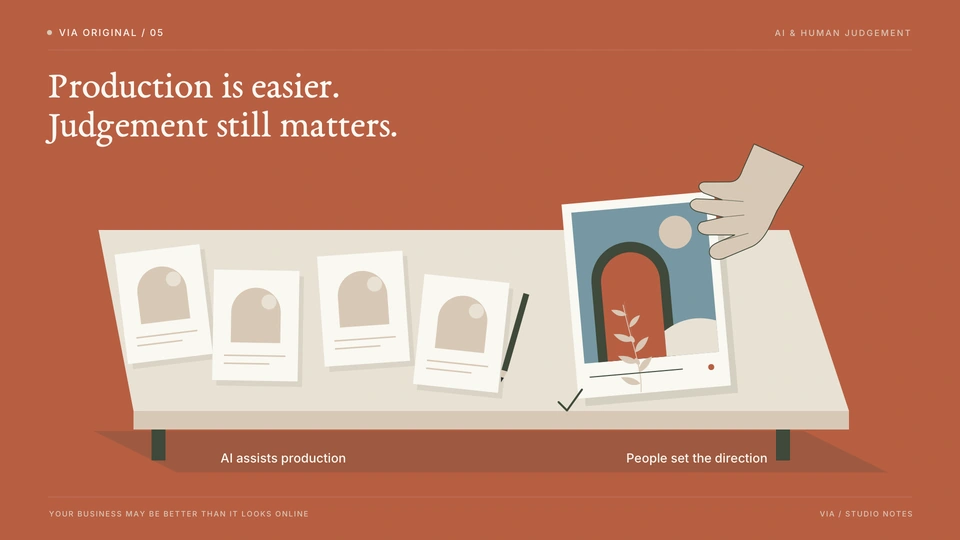
AI can make production cheaper. It cannot make generic work distinctive simply by producing more of it.
The scarce resource is shifting from production capacity towards judgement: knowing what is worth saying, what belongs to the brand, what should be removed and what deserves to become recognisable.
06. THE ONLINE PERCEPTION GAP
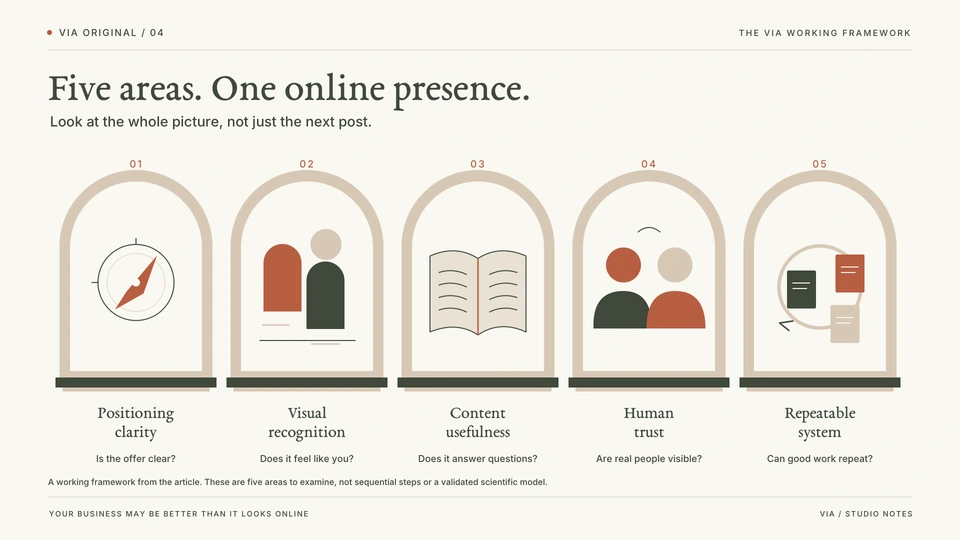
This leads to the framework I use when looking at a business online.
It is not a scientific model. It is a working framework developed from practice and informed by the research above.
I look for the gap across five areas.
01 — POSITIONING CLARITY
Can someone unfamiliar with the business quickly understand what it offers, who it is for and why it is relevant?
If the answer requires several paragraphs, three Instagram highlights and a call with the founder, the problem may not be content volume. It may be clarity.
02 — VISUAL RECOGNITION
Does the brand have a visual language or simply a collection of assets?
The objective is not rigid consistency. It is enough coherence that new material strengthens what came before it.
03 — CONTENT USEFULNESS
Does the content answer real questions, reveal expertise, demonstrate the product, explain decisions or give the audience a reason to return?
Beautiful content can attract attention.
Useful content gives attention somewhere to go.
04 — HUMAN TRUST
Can you feel that there are people, judgement and accountability behind the business?
Founder perspective, expertise, community interaction, customer evidence, thoughtful responses and original photography can all contribute here.
In an increasingly synthetic content environment, visible human judgement becomes part of the brand signal.
05 — REPEATABLE SYSTEM
Can the team produce good work without reinventing the process every week?
A mature content operation has memory.
It knows its pillars, formats, visual rules, approval process, source material and distribution logic. It can reuse an idea without merely duplicating it.
That is what allows consistency without creative exhaustion.
07. WHY I FOUNDED VIA
This perception gap is one of the reasons I founded VIA Studio.
Over years of working across social media, strategic communications, digital marketing, community and content, I kept seeing versions of the same problem.
The underlying business was often stronger than its digital representation.
Sometimes the positioning was unclear.
Sometimes the visual presentation did not reflect the quality of the work.
Sometimes a team was producing content constantly but rebuilding the process from zero each time.
Sometimes the missing piece was not content at all, but connection: the brand was broadcasting regularly without developing much conversation, community or recognition around it.
And increasingly, another layer appeared: teams had more tools than ever, but not necessarily more direction.
VIA was built around that problem.
Not around producing the maximum possible amount of content, but around making the distance between business quality and perceived quality smaller.
That can involve strategy.
It can involve photography, social content or art direction.
It can involve community.
It can involve AI and automation behind the scenes.
But the tools are secondary.
The question comes first:
Does this business look, sound and behave online at the level at which it actually operates?
08. BEFORE YOU PUBLISH MORE, AUDIT WHAT IS ALREADY THERE
A useful first audit does not need to be complicated.
Open your website and social profiles as though you have never encountered the business before.
Do not ask whether you personally like them.
Ask whether they communicate.
Can you understand the offer within seconds?
Can you tell who it is for?
Does the photography belong to the same world as the business?
Would you recognise the content without seeing the logo?
Are the most important customer questions answered?
Does the social presence demonstrate expertise or merely announce activity?
Is there evidence of real people, customers or community?
Do the different channels feel connected?
Could your team explain how content gets from idea to publication?
And perhaps the most revealing question of all:
If the logo disappeared, what would still make this unmistakably yours?
That is where the real work begins.
THE POINT IS NOT TO LOOK MORE EXPENSIVE
It is easy to misunderstand all of this as an argument for polishing everything until it appears luxurious.
It is not.
A neighbourhood café should not communicate like a private bank. A technology community should not look like a fashion house. A renovation company does not need to imitate an architecture magazine simply because architecture magazines are beautiful.
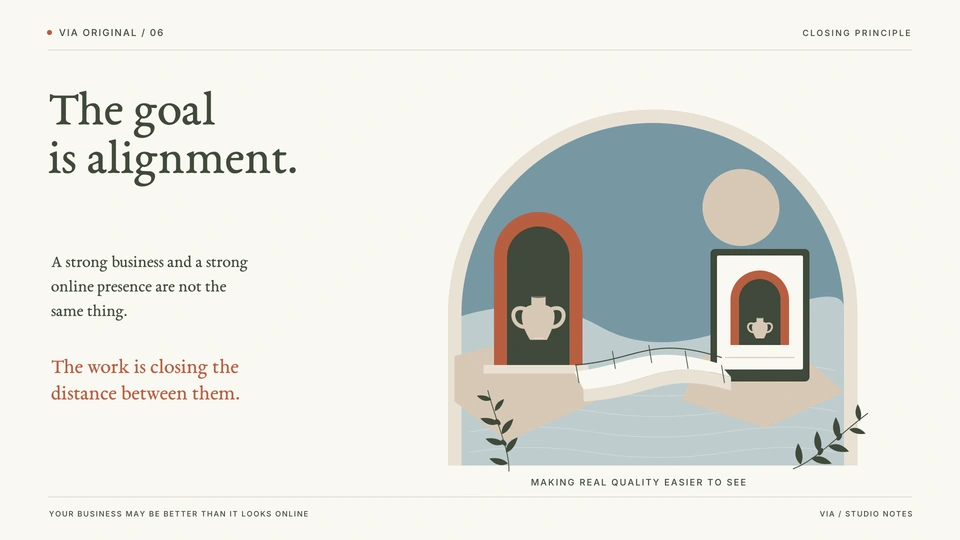
The goal is alignment.
A business should appear online with the same degree of clarity, confidence and consideration that exists in the business itself.
Sometimes that requires better design.
Sometimes better photography.
Sometimes fewer messages.
Sometimes more useful information.
Sometimes a stronger opinion.
And sometimes it requires a system behind the content so the team can stop beginning again every Monday morning.
The research does not tell us that aesthetics alone create trust, that originality guarantees growth or that AI-generated content inevitably damages a brand.
It tells us something more useful.
People notice presentation. They are becoming more selective about content. They respond to clarity and distinctiveness. And the rapid expansion of AI-generated material is changing the environment in which those judgements are made. Adobe
For businesses, that makes the objective surprisingly simple:
Do not merely produce more evidence that you exist online.
Build an online presence that makes the quality of the business easier to see.
VIA NOTE
A strong business and a strong online presence are not the same thing. The work is closing the distance between them.
RESEARCH NOTES
The principal research referenced in this essay includes Adobe Express's Design Index, based on 2,000 UK consumers and 500 freelancers; Sprout Social's 2026 consumer research, including its Q1 Pulse Survey and Social Media Content Strategy Report; and Adobe's research into small-business marketing and content practices. Survey findings describe reported attitudes and behaviours and should not be interpreted as proof that any single design or content intervention causes commercial growth. Adobe
Adobe — The Design Index · Sprout Social — 2026 Content Strategy Report · Sprout Social — Q1 2026 research