VIA ORIGINAL
WHEN AI MAKES CONTENT CHEAPER, WHAT STILL MAKES A BUSINESS WORTH CHOOSING?
What AI is commoditising in marketing — and what businesses still need strategy, creative direction and human judgement for in 2026.
VALENTYNA DYNOVSKA · Founder & Creative Director
VIA Original · Strategy & Creative Direction · 2026
AI has made content dramatically easier to produce.
A business can now draft captions, generate visual directions, create first-pass video, adapt one idea into multiple formats, analyse information and automate parts of its marketing workflow without building a large creative team.
And by 2026, this is no longer an experimental edge.
Canva’s 2026 State of Marketing & AI study, conducted with The Harris Poll across 1,415 marketing leaders and 3,547 consumers in seven countries, found that 97% of marketing leaders use AI in their daily creative work and 99% plan to increase AI investment in 2026. Yet the same research found that 41% of marketing leaders already see “AI slop” as a real problem. Canva
So the important question is no longer:
Can AI make content?
Obviously, it can.
The more interesting question is:
When everyone can make more content, what still makes one business worth choosing over another?
That is where the economics of creative work are starting to change.
Production is becoming cheaper.
Judgement is becoming more valuable.
01 — AI IS COMMODITISING PART OF THE OLD AGENCY MODEL
Some marketing work genuinely is becoming less valuable as a standalone service.
Generic captions.
Basic social calendars.
Simple graphics.
First drafts.
Routine resizing.
Basic repurposing.
Straightforward research summaries.
Simple edits.
Ten variations of essentially the same idea.
Businesses that once had to pay an external person to produce every one of these outputs can increasingly do part of that work themselves.
And creative studios should not pretend otherwise.
VIA NOTE
If an agency’s main value was simply that it could produce more content than the client could produce alone, AI is a serious challenge to that model.
But producing content and building a strong business presence are not the same job.
AI makes the first easier.
It does not automatically solve the second.
02 — THE MORE AI CAN GENERATE, THE MORE IMPORTANT SELECTION BECOMES
AI removes one of the old bottlenecks: generating options.
A team can now produce:
- dozens of campaign ideas;
- hundreds of headlines;
- multiple positioning statements;
- visual directions;
- content calendars;
- scripts;
- image concepts;
- repurposed formats.
But abundance creates a different problem.
Which idea is actually right?
Which visual direction looks distinctive rather than generated?
Which message should the business repeat for six months?
What should the brand stop saying?
What is culturally appropriate?
Which output looks cheap?
Which output is technically impressive but strategically wrong?
What should remain consistent even when platforms and trends change?
Canva’s 2026 consumer research captures this tension particularly well. 78% of consumers said they would rather see advertising made by people even if AI could produce better advertising, 87% said the best advertising still needs a human touch, and 70% said they can usually recognise AI-generated advertising because it feels as though something is missing. Canva
This is not an argument that AI produces bad work.
It is an argument that generation and judgement are different capabilities.
AI can increase output. It cannot decide what deserves to become the brand.
03 — SMALL BUSINESSES ARE ALREADY USING AI. THEY STILL DO NOT HAVE UNLIMITED TIME OR CREATIVE CAPACITY.
The idea that AI will simply turn every founder into their own marketing department sounds plausible until you look at what running a small business actually involves.
Adobe Express commissioned research among 1,000 US small business owners in April–May 2026. The average owner said they were filling five different roles every day, adding more than 200 extra working hours a year. Only 20% felt prepared for the creative and marketing demands of running the business. Half said they regularly use AI. Adobe
And when owners were asked what they would most like to hand off, marketing ranked at 21% and social media at 18%, behind only bookkeeping, finance and accounting. Adobe
That distinction matters.
AI can increase an owner’s capability.
It does not create more hours in the week.
And it does not mean that the owner wants to become:
a strategist,
creative director,
photographer,
copywriter,
social manager,
community manager,
video editor
and AI workflow designer
alongside actually running the company.
VIA NOTE
The question is not whether small businesses can use AI. Many already do. The question is which parts of marketing deserve the owner’s attention — and which parts should become easier, delegated or systemised.
04 — SMALL BUSINESSES ARE ALSO DISCOVERING THAT AI OUTPUT STILL NEEDS TASTE
Another Adobe study gets even closer to the issue.
In June 2026, Adobe Express and Morning Consult surveyed 850 US small business owners and solopreneurs about their use of AI in marketing.
66% were already using AI for marketing.
But adoption did not mean automatic publishing.
48% said they heavily edited their most recent AI-assisted content before publishing it. Only 6% published the output as generated. Adobe
This may be one of the most useful signals for businesses in 2026.
Access to AI itself is rapidly losing its ability to differentiate.
The differentiator becomes:
what you keep,
what you reject,
what you change,
what feels like your business,
what does not.
Adobe frames this as taste becoming a competitive advantage when businesses increasingly have access to the same generation tools. Adobe
That is very close to VIA’s position.
Access to AI is not the edge.
What you do with the output is.
05 — CUSTOMERS ARE BECOMING MORE SELECTIVE, NOT LESS
More content does not necessarily create more attention.
Sprout Social’s Q1 2026 Pulse Survey found that 66% of consumers said they had become more selective about the content they engage with compared with 12 months earlier. Sprout Social
At the same time, 83% said they encounter “AI slop” on social media at least sometimes, including 56% who said they see it often or very often. Sprout Social
The result is a strange paradox:
the supply of content is increasing while the audience becomes harder to impress.
That makes volume a weaker strategy on its own.
Publishing more cannot compensate indefinitely for:
weak positioning,
generic visual direction,
unclear messaging,
repetition,
lack of personality.
The bottleneck starts moving away from production and towards meaning.
06 — THE CUSTOMER STILL HAS TO CHOOSE A REAL BUSINESS
This is especially important for businesses where online perception forms part of the buying decision.
A boutique hotel.
A jewellery studio.
A yoga retreat.
A restaurant.
An interior designer.
A renovation company.
A beauty business.
A founder selling expertise.
Before a customer experiences the real business, they often encounter its digital representation.
They cannot yet know whether:
the room feels beautiful,
the therapist is good,
the jewellery feels substantial,
the renovation is meticulous,
the chef is exceptional,
the consultant is genuinely insightful.
They make an early judgement from what they can see.
The website.
The photography.
The feed.
The writing.
The reviews.
The founder.
The consistency.
AI makes producing those signals easier.
It does not make the signals irrelevant.
07 — HOSPITALITY IN ITALY MAKES THIS PARTICULARLY VISIBLE
Italy is a useful market in which to see this tension.
In Q1 2026, Italian accommodation businesses recorded 71.6 million overnight stays, up 7.5% year on year. International visitors accounted for 54.6% of total stays, and foreign overnight stays were up 12.3% compared with Q1 2025. Istat
The extra-hotel segment — including accommodation outside traditional hotels — grew particularly strongly, with overnight stays up 14.7% year on year. Istat
For hospitality businesses, online presentation is not a decorative layer added after the product.
It is often part of how the product is evaluated.
The customer is looking at:
the room,
the terrace,
the breakfast,
the beach,
the neighbourhood,
the pool,
the materials,
the people,
the atmosphere.
AI can help organise assets.
It can write descriptions.
It can suggest campaign concepts.
It can accelerate editing.
But somebody still has to decide:
What does this place really feel like — and how should that be shown?
For a business selling a physical experience, reality itself remains one of the strongest creative assets.
08 — AI CAN GENERATE A HOTEL IMAGE. IT CANNOT DOCUMENT THE HOTEL IN WHICH THE GUEST WILL ACTUALLY ENTER.
This distinction matters.
Synthetic imagery can be useful.
So can CGI.
So can generative concept development.
But when someone is choosing:
a room,
a restaurant,
a villa,
a retreat,
an interior designer,
a renovation company,
there are moments when the real thing matters precisely because it is real.
Light.
Material.
Scale.
People.
Craft.
Imperfection.
Location.
Atmosphere.
The question for creative direction is therefore not:
Can we generate this?
It is:
Should this be generated — or is reality itself part of what the customer needs to trust?
That is not a software question.
It is a judgement question.
09 — HUMAN PRESENCE BECOMES MORE INTERESTING AS SYNTHETIC PRESENCE BECOMES EASIER
This becomes even clearer for founder-led and people-led businesses.
Sprout Social’s 2026 Influencer Marketing Report found that only 17% of consumers check follower count before deciding whether to engage with a creator. Content relevance and style matter more. Sprout Social
The same research found that 40% of consumers discover new products or services through employee-generated content every month. Sprout Social
Meanwhile, 44% said they feel uncomfortable with brands using AI influencers. Sprout Social
That does not mean every founder needs to become an influencer.
It means there is continued value in visible human authorship.
A founder explaining a product.
A chef talking about ingredients.
A designer showing a process.
A hotel owner introducing the property.
A therapist speaking in their own voice.
A craftsperson showing the work.
A real person can communicate something synthetic production cannot always reproduce:
accountability.
There is somebody behind the business.
10 — HUMAN-GENERATED CONTENT IS NOW A STRATEGIC SIGNAL
Sprout’s larger 2026 Social Media Content Strategy Report, based on more than 2,300 consumers across the US, UK and Australia and 1,200 marketers, found that the number-one thing consumers wanted brands to prioritise was human-generated content. Sprout Social
The report’s recommendation is not to avoid AI.
It is almost the opposite.
Use AI where it creates leverage:
audience insight,
process efficiency,
analysis,
workflow support.
But do not assume that the best use of AI is simply generating more audience-facing content. Sprout Social
This distinction is fundamental.
Automate repetition.
Do not automate the point of view out of the brand.
11 — IN EUROPE, THE DATA POINTS TOWARDS HUMAN–AI COLLABORATION, NOT HUMAN REMOVAL
Canva’s dedicated 2026 European Marketing & AI Report arrives at a similar conclusion.
Among European marketing leaders:
- 74% expect creative roles to increase over the next five years;
- 59% say AI complements rather than competes with human imagination;
- 99% expect AI budgets to increase.
Among consumers, 65% said they do not want brands using AI to predict what they want. Canva
That combination is revealing.
Europe is not rejecting AI.
Investment is increasing aggressively.
But creative roles are not expected simply to disappear alongside that investment.
The emerging model looks more like:
AI increases creative velocity.
Humans remain responsible for direction.
12 — ITALIAN BUSINESSES ARE ALSO THINKING ABOUT AI AS AN OPERATING SYSTEM, NOT JUST A CONTENT GENERATOR
A May 2026 EY/SWG study of around 70 medium and large Italian companies found that 55% had already started or completed AI adoption projects. The most common applications included data analysis, administrative automation and production-process optimisation. EY
The same research found that 93% considered continuous training in emerging technologies necessary, while 59% reported demand for strategic support around innovation, ICT and AI. EY
This is not representative of every Italian small business — the sample was specifically medium and large companies — but it illustrates an important direction.
Businesses are increasingly asking not simply:
How do we generate something with AI?
but:
How do we integrate AI into the way the business actually works?
That is a much more valuable question.
13 — CREATIVE DIRECTION IS NOT PROMPT WRITING
AI literacy matters.
Prompt quality matters.
Tool selection matters.
But creative direction is broader than knowing how to instruct a model.
It includes:
reference judgement,
visual hierarchy,
editing,
cultural context,
composition,
tone,
restraint,
commercial context,
consistency,
knowing what to discard.
Canva’s global 2026 report summarises the shift clearly: as AI increases creative speed and volume, taste, judgement and cultural insight become the differentiators rather than output alone. Canva
That is why the creative role does not disappear merely because the production tool becomes more powerful.
A camera did not eliminate photography.
Canva did not eliminate design.
CapCut did not eliminate editing.
AI will eliminate some manual steps.
It will also expose which creative work was valuable only because the manual step used to be difficult.
14 — INTERIORS AND RENOVATION SHOW THE ONLINE PERCEPTION GAP PARTICULARLY WELL
Some businesses do not have a quality problem.
They have a communication problem.
A renovation company can complete beautiful work and still have an Instagram account made up of inconsistent phone photos.
An interior studio can have excellent projects but no coherent way of presenting them.
A craft brand can have decades of expertise while looking online like an interchangeable marketplace seller.
The real business may be stronger than the version visible online.
That is the online perception gap.
And AI can amplify either side of it.
Clear business + clear direction + AI
can produce a stronger, more efficient system.
Unclear business + unclear direction + AI
can produce more confusion faster.
VIA NOTE
AI scales the system you give it. It does not guarantee that the system is good.
15 — FASHION, BEAUTY, JEWELLERY AND LIFESTYLE STILL NEED MATERIAL AND CULTURAL JUDGEMENT
These sectors offer another useful example.
AI can help with:
concept development,
campaign exploration,
moodboards,
reference generation,
pre-production,
adaptation,
retouching,
storyboarding.
But real products have:
weight,
texture,
colour,
fit,
movement,
craft,
material detail.
And brands exist within culture.
What feels current without becoming generic?
What feels premium without becoming sterile?
What belongs to this market?
What already looks overused?
Which visual reference is appropriate for this brand but wrong for another?
These are not questions of generation capacity.
They are questions of taste and context.
16 — THE BEST AI SYSTEM MAY BE THE ONE THE CLIENT BARELY NOTICES
Most small businesses do not wake up wanting an “AI transformation”.
They wake up thinking:
We do not know what to publish.
Marketing takes too much time.
Everything feels inconsistent.
We keep repeating the same work.
Our website does not match the real quality of the business.
We have lots of material but no system.
We tried AI, but everything sounds generic.
Those are the actual problems.
AI may be part of the solution.
But the client does not need more technology for the sake of technology.
They need:
less repetition,
less friction,
more clarity,
better reuse,
better decisions.
VIA NOTE
A good AI system should make repetitive work less visible — not make the brand itself feel more artificial.
17 — WHERE AI IS ACTUALLY USEFUL
At VIA, we see the strongest role for AI in the work that should become easier to repeat.
PLANNING
Turning strategic priorities into a workable structure.
RESEARCH SUPPORT
Accelerating initial exploration and organising large volumes of information.
REPURPOSING
Turning one valuable asset into several useful formats.
ANALYSIS
Helping teams understand patterns, performance and audience signals faster.
TEMPLATES
Reducing the amount of work rebuilt from scratch.
AUTOMATION
Removing repetitive operational steps that do not require creative judgement.
This is consistent with what consumers are signalling in 2026:
they are not necessarily asking brands to stop using AI.
They are asking brands not to let efficiency replace meaning.
18 — COMMUNITY IS NOT JUST ANOTHER CONTENT FORMAT
AI can help community teams:
summarise conversations,
identify recurring questions,
prepare first drafts,
classify issues,
analyse sentiment.
But community requires context.
A complaint may need empathy.
A crisis may require escalation.
A loyal customer may deserve a different response from a first-time commenter.
Tone can change by market.
Humour can fail across cultures.
Silence can occasionally be more appropriate than a reply.
Relationship management is not simply another form of content generation.
It is judgement in context.
That becomes particularly important for founder-led and service businesses where reputation and trust are closely connected to real people.
19 — THE OLD QUESTION WAS: WHO CAN MAKE THE CONTENT?
For years, businesses outsourced because somebody else knew how to:
write,
design,
shoot,
edit,
publish.
Those skills still matter.
But basic access to production is becoming widely distributed.
The better questions for 2026 are:
What should this business be known for?
What should a new customer understand immediately?
What should be unmistakably ours?
Which ideas deserve production?
Which assets need to be real?
Where does visible human presence increase trust?
Which parts of the process should be automated?
Which decisions should remain human?
What should we stop producing?
These are questions of strategy and creative direction.
Not volume.
20 — WHAT A CREATIVE & SOCIAL STUDIO SHOULD ACTUALLY SELL IN 2026
The old promise:
We can make content for you.
is becoming weaker.
A more useful model is:
DIAGNOSIS
Understand why the current presence does not reflect the quality of the business.
STRATEGY & CREATIVE DIRECTION
Decide what the brand should communicate, show, repeat and become recognisable for.
CONTENT PRODUCTION
Create the real photography, video, writing and material the business actually needs.
SOCIAL & COMMUNITY
Turn isolated assets into a consistent presence and ongoing relationship.
AI-POWERED SYSTEMS
Remove unnecessary repetition and make useful processes easier to repeat.
AI therefore belongs inside the studio model.
It just should not become the entire reason the studio exists.
21 — THE CHEAPER CONTENT BECOMES, THE MORE EXPENSIVE CONFUSION BECOMES
When production becomes easier, the obvious reaction is to produce more.
More Reels.
More posts.
More channels.
More campaigns.
More versions.
More AI output.
But every piece of communication teaches the customer something about the brand.
If those signals are inconsistent, generic or contradictory, more volume can make the business harder rather than easier to understand.
The fundamental scarcity may no longer be content.
For many businesses, it is:
CLARITY.
They already have:
Instagram.
Canva.
ChatGPT.
A camera.
Old photographs.
A website.
A mailing list.
What they may not have is a clear answer to:
What should all of this add up to?
22 — WHAT THIS MEANS FOR BUSINESSES IN ITALY AND EUROPE
Europe in 2026 is not moving towards a simple choice between AI and human creativity.
AI investment is rising while European marketing leaders simultaneously expect creative roles to grow and describe AI as complementary to human imagination. Canva
In Italy, tourism is growing strongly, including internationally, while larger businesses are actively investing in AI, skills and digital transformation. Istat
That creates an interesting environment for businesses built around:
hospitality,
travel,
fashion,
beauty,
wellness,
food,
interiors,
craft,
renovation,
founder expertise.
Many of these businesses are inherently physical and human.
Their challenge is not simply to become “more digital”.
It is to translate real quality into a digital presence without flattening what makes the business distinctive.
Not every small business needs a creative studio.
Some genuinely need only:
accurate Google information,
strong photographs,
a functional website,
an active social profile.
But where perception affects:
trust,
price,
desirability,
reputation,
choice,
the quality of the online presentation becomes commercially meaningful.
23 — BEFORE YOU CREATE MORE, ASK THIS
Before making another month of content:
- Can a new person understand what we offer within seconds?
- Does our online presence reflect the real quality and price of the business?
- Would anyone recognise our content without seeing the logo?
- Are we producing because something deserves to be communicated — or because the calendar says Tuesday?
- Which parts of our content require real people, places and products?
- Where could AI remove repetition without removing personality?
- Who has responsibility for rejecting mediocre output?
- What should never be automated?
- What should we stop making entirely?
- If AI allowed us to produce twice as much tomorrow, would the business become twice as clear?
If the last answer is no, the bottleneck probably is not production capacity.
THE POINT IS NOT TO PROTECT CREATIVE WORK FROM AI
It would be easy for the creative industry to frame AI as an enemy.
That is not VIA’s position.
We use AI.
We think it can make research, planning, adaptation, analysis and repeatable workflows dramatically more efficient.
We also think some creative tasks that once justified considerable agency fees will continue to become cheaper.
That is healthy.
Businesses should not pay people to perform repetitive manual work simply because it used to be difficult to automate.
But efficiency and distinctiveness are different things.
A system can help a business produce faster.
It cannot independently decide what that business should become known for.
VIA NOTE
Use AI for the work that should be repeatable.
Keep human judgement for the work that should remain distinctive.
The question for 2026 is no longer whether businesses should use AI.
They will.
The more useful question is:
WHERE SHOULD AI END — AND JUDGEMENT BEGIN?
RESEARCH NOTES
Canva — The State of Marketing & AI Report 2026. Conducted with The Harris Poll among 1,415 marketing leaders at organisations with 500+ employees and 3,547 consumers across the US, UK, Australia, France, Germany, Japan and India. Findings used here include 97% daily AI use among marketing leaders, 99% planned increase in AI investment, 41% identifying AI slop as a challenge, 78% consumer preference for human-made ads, 87% saying the best advertising still requires human touch and 70% saying AI-generated ads can often be recognised because something feels missing. Canva
Canva — State of Marketing & AI in Europe 2026. Findings used: 74% expect creative roles to increase over the next five years; 59% say AI complements rather than competes with human imagination; 65% of consumers do not want brands using AI to predict what they want; 99% of marketing leaders expect AI budgets to increase. Canva
Adobe Express / Morning Consult — AI Snapshot for Small Business, June 2026. Survey of 850 US small business owners and solopreneurs, fielded 1–22 June 2026. 66% used AI for marketing; 48% heavily edited their most recent AI-assisted content before publishing; 6% published it as-is. Adobe
Adobe Express / Talker Research — Small Business Owners, April–May 2026. Survey of 1,000 US small business owners, fielded 29 April–3 May 2026. The average owner filled five roles, accumulating more than 200 additional working hours a year; only 20% felt prepared for creative/marketing demands; half regularly used AI; marketing and social media were among the functions respondents most wanted to hand off. Adobe
Sprout Social — 2026 Social Media Content Strategy Report. More than 2,300 consumers across the US, UK and Australia plus 1,200 marketers. Consumers ranked human-generated content as the number-one priority for brands; the report recommends using AI for audience intelligence and process efficiency rather than as a substitute for human taste. Sprout Social
Sprout Social — Q1 2026 Pulse Survey. 66% said they were more selective about content than a year earlier; 83% encountered AI slop at least sometimes and 56% often or very often. Sprout Social
Sprout Social — 2026 Influencer Marketing Report. Only 17% of consumers checked follower counts before engaging with a creator; 40% discovered products or services via employee-generated content monthly; 44% felt uncomfortable with brands using AI influencers. Sprout Social
ISTAT — Tourism flows, Q1 2026. Italian accommodation businesses recorded 23 million arrivals and 71.6 million overnight stays. Overnight stays rose 7.5% year on year; international visitors accounted for 54.6%, with foreign stays increasing 12.3%. Extra-hotel overnight stays rose 14.7%. Istat
EY Private / SWG — Italian entrepreneurship survey, May 2026. Survey of approximately 70 medium and large Italian companies. 55% had started or completed AI adoption projects; 93% emphasised the need for continuous emerging-technology training; 59% indicated demand for strategic support around innovation, ICT and AI. These findings should not be generalised to all Italian SMEs because of the sample composition. EY
IMAGE CREDITS
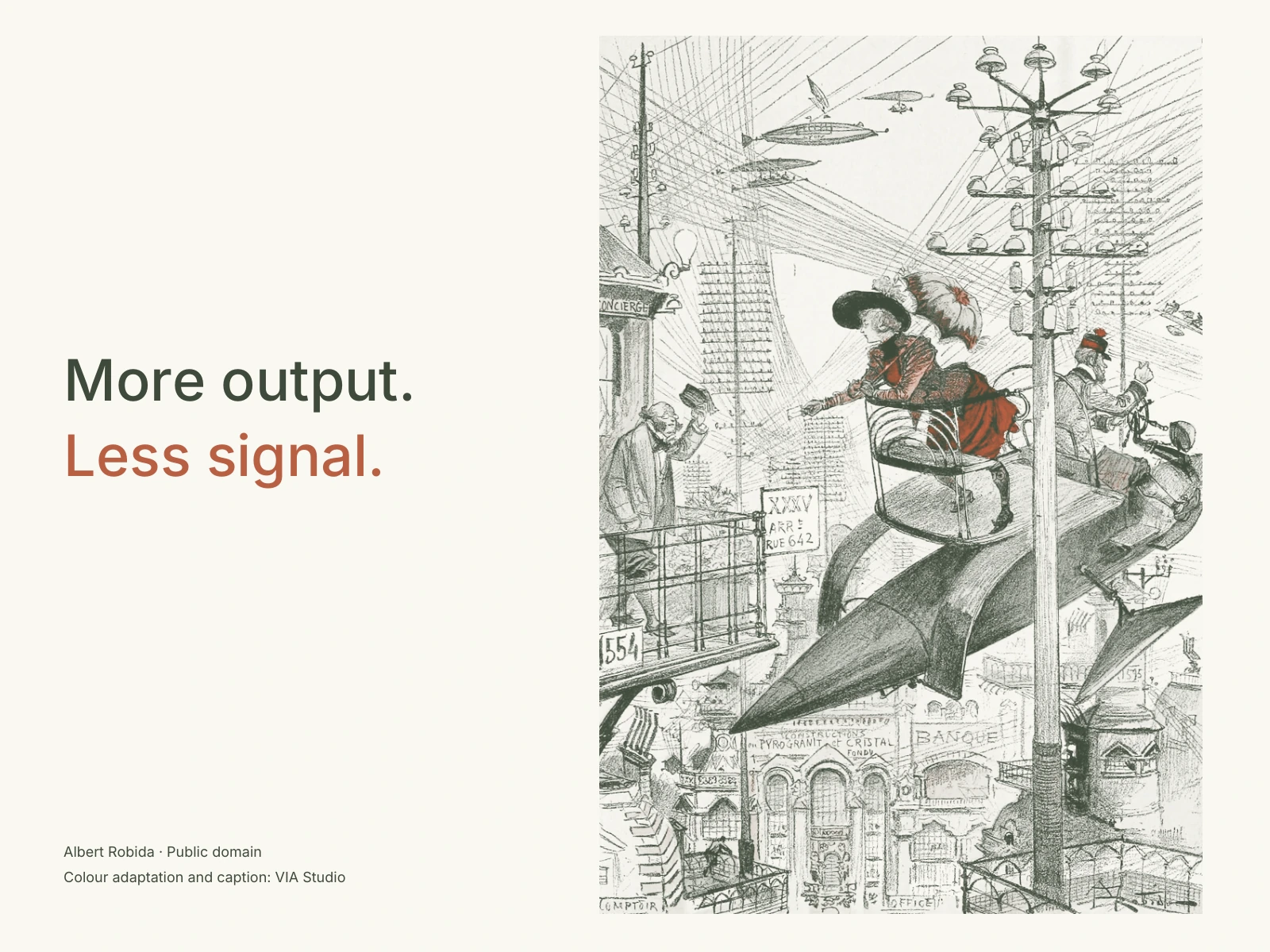
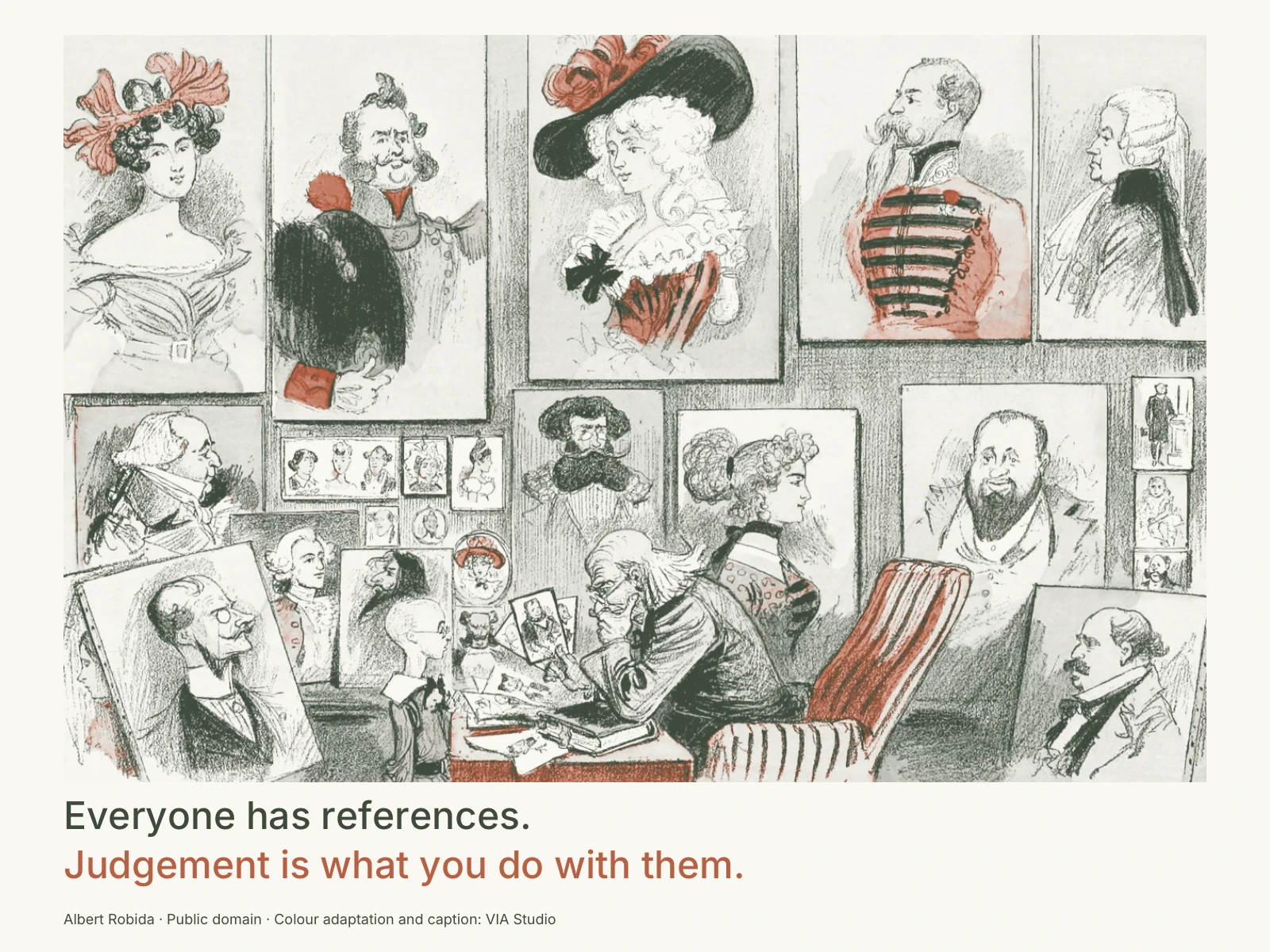
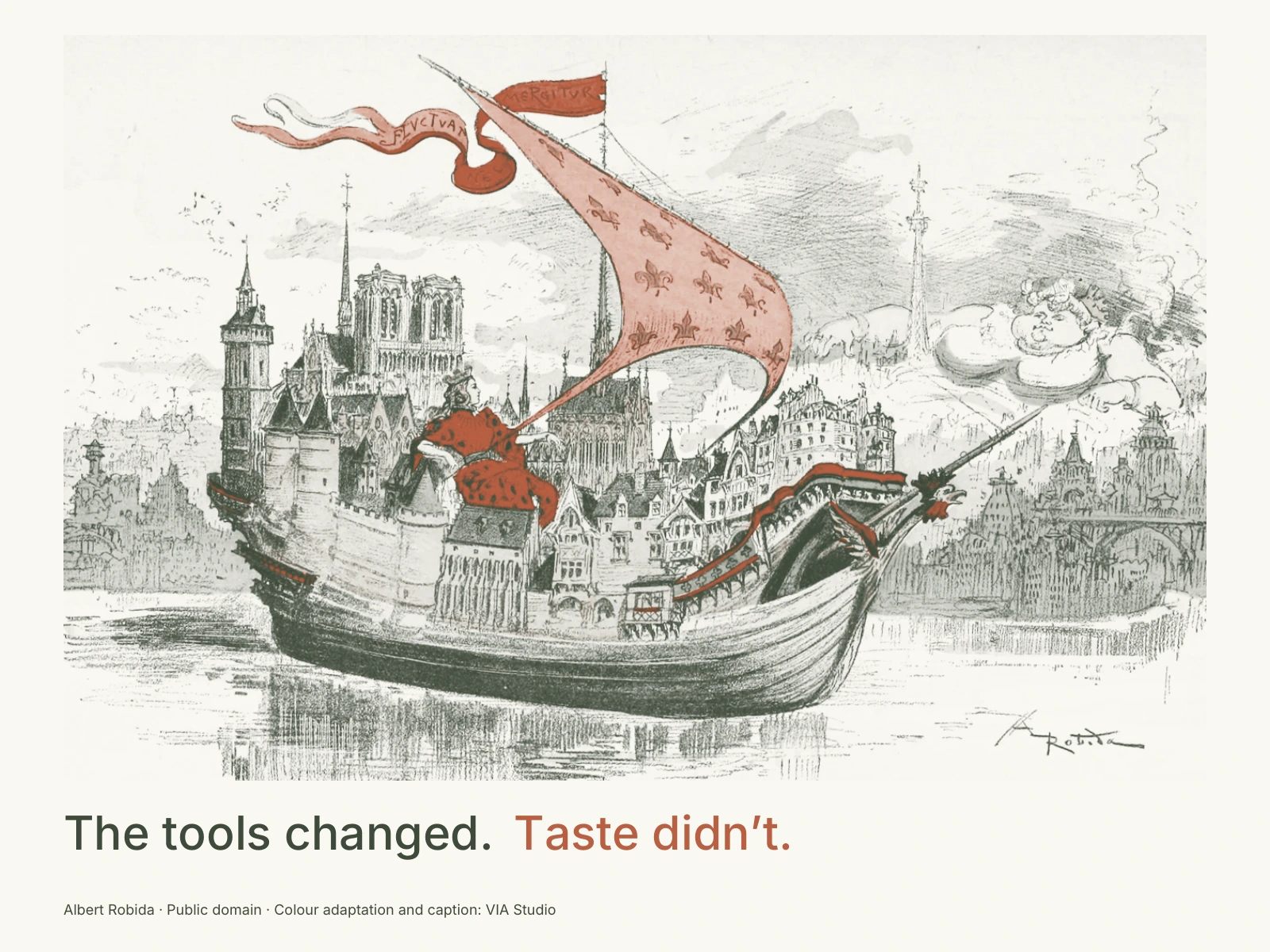
Historical illustrations by Albert Robida (La vie électrique). Colour adaptation and contemporary editorial captions by VIA Studio. The English captions shown on the illustrations are VIA’s editorial additions — they are not quotations by Robida.
A Busy Neighbourhood — Public Domain Archive
A Grand Selection of Ancestors . . . Whose Influence Will Dominate? — Public Domain Archive
The Old and the New — Public Domain Archive
Collection: Albert Robida, La vie électrique — Public Domain Review
The archive states for these items: Underlying Rights: Public Domain Worldwide · Digital Rights: No Additional Rights · Source: Internet Archive / The Getty. It notes no associated rights statement on Internet Archive, but says the source confirmed by email that there are no additional rights. The archive offers this information as guidance only.
The individual image pages use 1890; the collection bibliography identifies the 1893 Paris edition. No ambiguous date has been printed on the adaptations.
Edits performed for VIA: cropped scan edges; paper white normalisation; olive ink and terracotta pigment mapping; added separate contemporary editorial captions in Inter. No generated pictorial content. The derivative files are colour adaptations, not untouched archival scans.